Saturday, August 24, 2013

Quran Burning and Unity Day USA


Purpose:

It is a purposeful event to bring Americans of different faiths, races, ethnicities and other uniqueness together to rededicate ourselves to our pledge; One nation under God with liberty and Justice for all. We will pray for peace, prosperity and security of our nation.
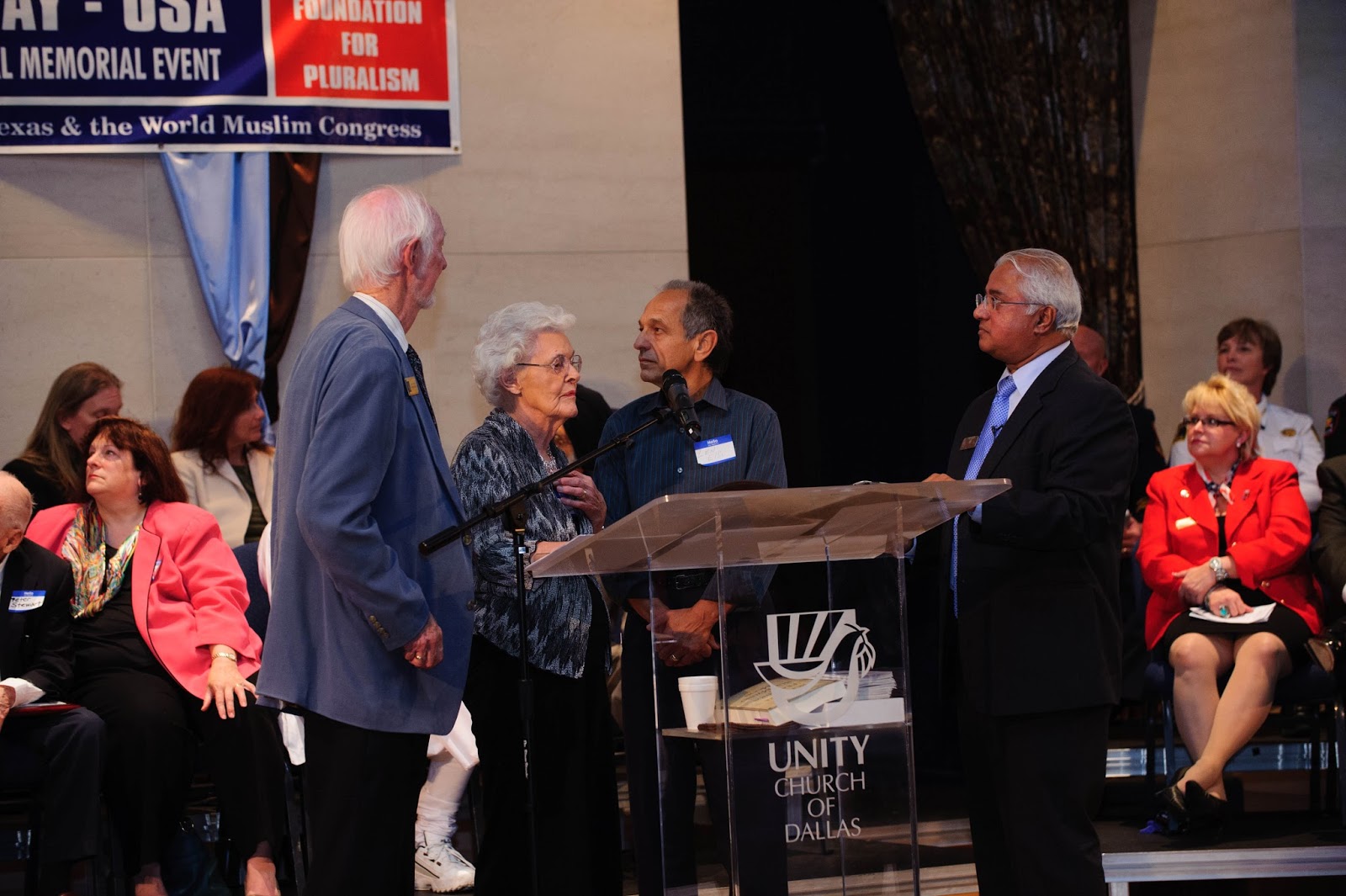
PICTURES FROM UNITY DAY IN DALLAS

The 10th Annual event is moved to Mulberry, Florida - for a singular purpose - to mitigate possible apprehensions generated by the planned burning of 2998 copies of Quran on September 11, 2013. We hope it restores our faith in the cohesiveness of America, and we the people will go on about our business of living our daily lives. 


Date 9/11/2013 in Mulberry - place and time will be announced soon.

We honor the free speech guaranteed in our constitution, and have no intentions to criticize, condemn or oppose Pastor Terry Jones freedom of expression.  Instead, we will be donating blood and praying for goodness to prevail.
We hope, our mercy based message will remind those few Muslims elsewhere in the world that violence is not the way. We believe it may bring a change in the attitudes of followers of Pastor Jones, and in the behavior of those Muslims who reacted violently the last time Pastor sought notoriety. The full press release: http://worldmuslimcongress.blogspot.com/2013/08/planned-muslim-response-to-quran_18.html

We will gather;
  1. to be together as Americans
  2. to express our gratitude to our men and women in uniform
  3. to honor individuals who have contributed to the well being of Mulberry, Florida
  4. to emphasize and appreciate diversity represented by America.
  5. to cherish the otherness of others. 
  6. to commit to be good neighbors 
  7. to rededicate our pledge to the peace, prosperity and security of America

Please join us with your family and friends to be together as Americans. Your presence is a valuable expression of unity. Along with our elected officials, civic, religious and business leaders, you help fulfill our common values and aspirations. Your presence fortifies our commitment to a pluralistic America.
As Americans, and as American of all hues, we uphold, protect, defend and celebrate the values enshrined in our constitution. All our faiths reinforce the creed of "One Nation under God, with liberty and justice for all”.
On this Unity Day USA, we, the people of the United States of America of every faith, race and ethnicity, will gather to express our commitment to co-existence, safety, prosperity and the well being of our nation.
PROGRAM OUTLINE

10th Annual Unity Day USA
Wednesday, September 11, 2013 
Mulberry, Florida
TIME: TBD

Flag Ceremony


National Anthem  
(Preferably joined in by members of at least 7 faith traditions, if not all)

Pledge of Allegiance 
To be led by the Hon. Mayor of Mulberry
   
Purpose of Unity DayThank Yous and Acknowledgements

Greetings
Greetings from several religious traditions a few Video Samples;  City of Carrollton-II - City of Carrollton  Chicago Bible College

Civic Leaders
Mayors, Police and Fire chiefs, and Civic Leaders to share 3 minutes each – about their responsibility in treating each citizen with respect and dignity 

Honoring the activists 
Those who have stood up for others


Spiritual Leaders
Spiritual Leaders to share their wisdom – 3 minutes each. In Dallas we bring 15 traditions, here we can do as many as we can gather – between Atheist (all Americans need to be represented), Baha’i, Buddhist, Christian (as many denominations as we can), Earth Based, Hindu, Jain, Jewish, Muslim, Native Americans, Pagan, Sikh, Shinto, Wicca and Zoroastrians.
 

Peace Pledge
  • I will I will speak up when there is injustice.
  • I will speak up when truth is not spoken.
  • I will make my words and my actions mitigate conflicts.
  • I will do my share in nurturing goodwill for the benefit of all.
  • I will do my share of peace work, without looking for others 
  • I will do respect the God given uniqueness of each individual.
  • I will do my best to live and let others live their way.
  • I will do my best to nurture goodwill in everything I do.
Special Muslim prayer ( 3-4 Minutes)

Pray for the well being of all Americans, and pray for Reverend Terry Jones, and seek forgiveness for all of us, and that God guide to Guide Reverend Terry Jones to become a be blessed peace maker. Pray for the goodwill of the people of Polk county and Mulberry City, and pray for a cohesive America, where no American needs to live in apprehension, discomfort or fear or fellow Americans.


Conclusion – Thank you.
Depending on the time and place – we can arrange soft drinks, cookies and munchies.


Unity day 2009
Unityday 2006
Thank you.
Mike Ghouse 
(214) 325-1916 text/talk
www.AmericaTogetherFoundation.com
www.FoundationforPluralism.com
www.UnitydayUSA.com

Friday, August 23, 2013

Quran Burning Video

A VIDEO MESSAGE TO MUSLIMS AND
PASTOR JONES ABOUT QURAN BURNING

http://www.youtube.com/watch?v=VsQq-tbJ89k&feature=youtu.be


Information at www.WorldMuslimCongress.com

Thanks
Mike

Thursday, August 22, 2013

Muslim Response to Qur'an Burning

URL- http://worldmuslimcongress.blogspot.com/2013/08/planned-muslim-response-to-quran_18.html

PLANNED MUSLIMS RESPONSE TO QUR'AN BURNING BY PASTOR JONES ON 9/11/13 IN MULBERRY, FLORIDA

We as Muslims plan to respond to pastor Terry Jones' planned burning of 3000 copies of Quran on September 11, 2013 in positive terms.

Our response - we will reclaim the standard of behavior practiced by the Prophet concerning “scurrilous and hostile criticism of the Qur’an” (Muhammad Asad Translation Note 31, verse 41:34). It was "To overcome evil with good is good, and to resist evil by evil is evil." It is also strongly enjoined in the Qur’an in the same verse 41:34, “Good and evil deeds are not equal. Repel evil with what is better; then you will see that one who was once your enemy has become your dearest friend.”

God willing Muslims will follow the divine guidance and pray for the restoration of Goodwill, and on that day many Muslim organizations will go on a “blood drive” to save lives and serve humanity with kindness.

We invite fellow Americans of all faiths, races, and ethnicities to join us to rededicate the pledge, “One nation under God”, and to build a cohesive America where no American has to live in apprehension, discomfort or fear of fellow Americans. This event is a substitute for our 10th Annual Unity Day Celebration (www.UnitydayUSA.com) held in Dallas, but now it will be at Mulberry, Florida.

Unwittingly Pastor Jones has done us a favor by invigorating us by his decision to burn nearly 3000 copies Quran on September 11, 2013. Obviously he is not satisfied by the notoriety he garnered by burning one Qur'an last year.

As Muslims and citizens we honor the free speech guaranteed in our constitution. We have no intentions to criticize, condemn or oppose Pastor Terry Jones' freedom of expression. Instead, we will be donating blood and praying for goodness to permeate in our society.

We plan to follow Jesus Christ (pbuh), a revered prophet in Islam as well as Prophet Muhammad (pbuh) – that of mitigating the conflicts and nurturing good will for the common good of the society.

We hope, this event and the message will remind Muslims elsewhere in the world as well, that violence is not the way. Muslims, who react violently to senseless provocation, should realize that, violence causes more violence, and besmirches the name of the religion that we hold so dear. We believe that Prophet Muhammad was a mercy to the mankind, and we ought to practice what we believe and preach. We must not insult Islam by the negative reactions of a few.

We can only hope it will bring about a change in the attitude of the followers of Pastor Jones, and in the behavior of those Muslims who reacted violently the last time Pastor sought notoriety – We hope this small step towards a bridge to peaceful coexistence would propel us towards building a cohesive society.

Like most Americans a majority of Muslims quietly go about their own business, but it is time to speak up and take positive action instead of negative reaction. May this message of peace and goodwill reverberate and reach many shores.

Lastly, we appreciate the Citizens of Mulberry, Florida, Honorable Mayor George Hatch, City Commissioners, police and Fire Chiefs for handing this situation very well. This will add a ‘feather of peace’ in the City’s reputation. We hope Mulberry will be a catalyst in showing the way in handling conflict with dignity and peace.

We thank the Media for giving value to the work towards peace rather than conflict.


https://blogger.googleusercontent.com/img/b/R29vZ2xl/AVvXsEiHcyDXXrlKx6YHffLnP0Ze1GTkcr75Hnqozo-lgAQDFZbxsik6eHu-E8tvj6RhKtSqwC9uh1iBKGgR4s98v9OVRrFBGuj4amXkOWkf5WubFEMiCOlVNq6GrjEThgvGksHPVp3XvGWLmck/s1600/Muslim.response.to.Quran.burning.Pastor.Jones.jpg


CONTACT:
Mike Ghouse
Text/Talk: (214) 325-1916
MikeGhouse@aol.com

Mirza A Beg
(205) 454-8797
mirza.a.beg@gmail.com

www.WorldMuslimCongress.com

Thank you.
. . . . .

Mike Ghouse is a speaker, thinker and a writer on pluralism
, politics, peace, Islam, Israel, India, interfaith, and cohesion at work place. He is committed to building a Cohesive America and offers pluralistic solutions on issues of the day at www.TheGhousediary.com. He believes in Standing up for others and has done that throughout his life as an activist. Mike has a presence on national and local TV, Radio and Print Media. He is a frequent guest on Sean Hannity show on Fox TV, and a commentator on national radio networks, he contributes weekly to the Texas Faith Column at Dallas Morning News; fortnightly at Huffington post; and several other periodicals across the world. His personal site www.MikeGhouse.net indexes all his work through many links.

Saturday, August 3, 2013

The Qur'an: A New Translation by Tarif Khalidi

The Qur'an: A New Translation
By Tarif Khalidi
530pp, Penguin Classics, £25 

 We look for two things in any new translation of the Qur'an. How close does it get to communicating the meaning of the original, that inimitable oral text, the very sounds of which move men and women to tears and ecstasy? And does it offer something more: a new perspective, perhaps; or an innovative rendering?
    Tarif Khalidi, a professor of Islamic studies at the American University of Beirut, scores high on both these criteria. He manages to capture the allusiveness of the text, as well as something of its tone and texture. While being faithful to the original, he succeeds in conveying linguistic shifts, from narrative to mnemonic, sermons to parables. And there is an innovative component: it is the first translation that tries to capture both the rhythms and the structure of the Qur'an.

    The best way to demonstrate its newness, and how close it is to the original text, is to compare it with an old translation. The translation I have in mind is Khalidi's predecessor in the Penguin Classics: The Koran, translated with notes by NJ Dawood. First published in 1956, Dawood's translation has been republished in numerous editions. It has been a great source of discomfort for Muslims, who see in it deliberate distortions that give the Qur'an violent and sexist overtones. It is the one most non-Muslims cite when they tell me with great conviction what the Qur'an says.

    The change can be detected with the name of the sacred text itself: we move from "Koran", the older anglicised form, to the new "Qur'an", which is now accepted as the correct Arabic transliteration and pronunciation of the word. This is not just a trivial matter of linguistics; it signals a shift from the old Orientalist way of presenting the Qur'an in English to a new inclusive way that takes Muslims' appreciation of their sacred text into account.

    Subtle differences in chapter headings signal significant change. The opening chapter of the Qur'an in Dawood is "The Exordium". In Khalidi, and indeed universally among other translations, it is "The Opening". Dawood translates Az-Zumar (chapter 39) as "The Hordes", suggesting bands of barbarian mobs; Khalidi renders it as "The Groups".

    While Dawood's translation presents the Qur'an as a patriarchal, sexist text, Khalidi brings out the gender-neutral language of the original. A good example is provided by 2:21. In Dawood we read: "Men, serve your Lord." In Khalidi, it becomes: "O People! Worship your Lord." Dawood's translation of the famous verse 2:25, frequently quoted, is largely responsible for the current misconception that Muslim paradise is full of "virgins" - despite the fact that the Qur'an explicitly denies any carnal pleasures in paradise. This is because we find "men" in Dawood's translation in the garden of paradise who are "wedded to chaste virgins". Khalidi renders it correctly: "In these gardens they have immaculate spouses."

    The old Penguin translation uses rather obscurantist images throughout to give the impression that the Qur'an is full of demons and witches. For example, in 31:1, Dawood has God swearing "by those who cast out demons". Khalidi translates the same verse as: "Behold the revelations of the Wise Book."

    So this translation is a quantum leap ahead of the old Penguin version. But it also has a rather special character. Khalidi is not interested in providing the context of the verses of the Qur'an. We therefore do not always know who the Qur'an is addressing at various junctures or who is speaking to whom in its internal dialogues. Here M Abdel-Haleem' s translation (OUP, £7.99), published in 2004, is more useful. Neither is Khalidi all that concerned with providing the reader with help. Footnotes, for example, would have been useful for occasional explanation of what is happening in a particular passage. Instead, he takes a rather unusual attitude to the Qur'an. It is "a bearer of diverse interpretation" , he says; and its ambiguities are deliberately designed to stimulate thinking. Let the reader be "patient of interpretation" and read at will. All that is needed is to approach the text with sympathy.

    Khalidi wants the reader to enjoy the experience of reading the Qur'an. Of course, he wants to communicate the majesty of its language, the beauty of its style, and the "eternal present tense" of its grammar. But he also wants the reader to appreciate the Qur'an's unique structure, how the language changes with the subject matter, how it swirls around and makes rhythmic connections. He wishes to show how each of the seven tropes of the Qur'an (command, prohibition, glad tidings, warnings, sermons, parables and narratives) registers a change in the style of its language. A lofty ambition, but one he pulls off with some success.

    The shifts in style are presented in two ways. Linguistically, Khalidi moves from literal translation, rendered in clear prose, via the use of heightened language to deeply poetic renderings. Physically, the layout of the passage changes, so each style looks different on the page. The narrative passages, or sections dealing with social and legislative affairs, appear in a prose format. The dramatic and metaphysical sections are arranged in poetic style.

    This translation manages to give a glimpse of the grandeur of the original. Khalidi's poetic sections will be compared with AJ Arberry's The Koran Interpreted (OUP, 1964), widely considered to be the most poetic of all translations. While I still prefer Arberry, Khalidi compares very favourably.

    But, for the life of me, I cannot see why poetic translations cannot number the verses consistently and consecutively. Like Arberry, Khalidi provides verse numbers on the side margins non-consecutively. There are a couple of other unforgivable omissions. In the main text, the chapters have no numbers. While there is a short glossary, there is no index. I found the translation very difficult to navigate.
    These omissions notwithstanding, this is a magnificent achievement. And Penguin, which had a rotten image among Muslims thanks to Dawood's translation, has redeemed itself.
Saturday June 21, 2008, The Guardian, London
Buy The Qur'an: A New Translation at the Guardian bookshop
Ziauddin Sardar blogs on a different verse or theme of the Qur'an weekly at blogs.guardian. co.uk/quran

URL: http://www.newageislam.com/books-and-documents/the-qur-an--a-new-translation---the-eternal-present-tense/d/195

Saturday, June 22, 2013

Quran for living day to day

 
Injunctions for Social Living
Compiled by Muhammad Latif Chaudhery
 
Social injunctions are not generally included in the category of LAWS. But if any social evil becomes rampant in society, an Islamic Government can make them statutory. Some social injunctions are described as under:

1. Moderation in expenses.
i) "Eat and drink but waste not by excess." (7:31)

ii) Do not spend without reason (need). Those who do so are the brethren of Satan. (17:26-27)

2. Get-up.
a) Use of things that produce beauty and elegance is lawful. None can proclaim them as unlawful. Details have already been given under the heading 'Lawful and Unlawful'. (7:32)

b) Apparels provide cover for body as well as elegance for a person. (7:26)

3. Physical and Mental Capabilities.
Knowledge (mental capability) and physical strength, are both necessary. When Taloot was made commander of Israelites, they had objected to it for his not being a wealthy person and asked: "What are his qualifications for which he has been made a commander" The reply was as follows: (2:247)

"Allah has chosen him above you and has gifted him abundantly with knowledge and bodily prowess". That is why he is chosen as your commander.

4. Conversation.
a) Always converse in clear, straightforward and decisive language, which contains no ambiguity: (33:70)

b) Use language, which is recognised by society and commonly used. (4:5) "Speak to them in words that are commonly recognised and used."

Also adopt an elegant manner for speech: (2:83) "And speak to men in a charming way."

c) (22:30) "And shun the words that are deceitful and showy".

d) (6:153) "When you say something, say with justice and equity, even if it goes against your relatives."

"Do not shout, a shrieking voice is disliked by others". (31:19)

"Speak softly, for the harshest of sounds, without doubt, is the braying of any ass."

5. Absurd and immodest talk.
Avoid all absurdities. One of the qualities of the believers has been stated as (23:3) "They avoid vain talk". The word "Laghw" means vain as well as meaningless. In Surah Al-An'aam (6th Chapter of the Quran) it is said: (6:151) this includes all sorts of immodesties __ even an immodest talk __ as it arouses lewd passions.

6. Walking.
i) Do not walk in haughtiness, be moderate (31:18-19) also (17:37)

"Do not be haughty while walking, adopt moderation in your gait."

ii) When you go out, do not allow your gaze to become bold and daring. This has been ordained both for men as well as women.

For men: (24:30)

And for women: (24:31)

7. Thoughtfulness to ponder and to comprehend.
i) Do not follow a thing without an inquiry into it. (17:36)

"Remember! Pursue not that of which you have no knowledge (which you have not inquired personally). Personal inquiry means that you gain knowledge of it through your senses of hearing and sight and on this basis, decide by your own intellect. If any link of this manner is broken, your inquiry shall remain incomplete. Look! How great is your responsibility in this matter, because Allah has given you 'will' and the faculty of 'choice'; you are not a inanimate machine. For the use of this faculty, He has provided you means of investigation. One who does not make use of them, shirks his own responsibility.

This is an important injunction which if acted upon properly, turns all conspiracies and the intrigues into a complete failure and a peaceful atmosphere prevails in society."

ii) Always ponder over things: see, hear, comprehend and then make decisions intellectually. For those who do not do so, it is said: (7:179)

Many are (amongst) the people (both) civilised and uncivilised whom We have made for hell. "They have mind wherewith they understand not, eyes wherewith they see not, and ears wherewith they hear not; they are like cattle, _ nay more astray, (because cattle, at least, follow their natural instincts). These people are heedless of warning".

iii) When you hear a good thing, act upon it; and when you hear an absurd one keep yourself away from it. (2:285) "We hear and we obey", has been called the believers way. And also (28:55) "And when they hear vain talk, they turn away therefrom".

8. Spying.
"Do not spy on other people's affairs that concern you not". (49:12)

9. Knowledge.
i) A learned person and an illiterate one cannot be at par: (39:9) "Say: Are those who know and those who do not know, equal to each other"

ii) Never think that you have reached the final stage of knowledge and nobody knows more than yourself. Remember! (12:76) "And above everyone endowed with knowledge is another endowed with more knowledge."

Nor say that my cup of knowledge is full and I do not want to know any more. Such mentality has been attributed to the non-believers. (2:88) "They say: our hearts do not need any outside information nor is there room in them for anything more to enter".

Not to speak of others, in this respect even the Nabie was asked to keep praying. (20:114) "O My sustainer! Advance me in knowledge."

10. Social relations.
When you meet each other, offer good wishes and blessings for safety. Thus it is said: (4:86) "One who conveys to you a message of safety and security and also when a courteous greeting is offered to you, meet it with a greeting still more courteous or (at least) of equal courtesy."

When you enter your own house or the house of somebody else, compliment the inmates. (24:61) "As has been said earlier (24:27) enter not houses other than your own until you have sought permission; and then greet the inmates and wish them a life of blessing, purity and pleasure from the grace of the Almighty Allah."

11. Good behaviour.
i) Extend kind and good behavior to your parents kinsfolk, orphans, neighbors, friends, travelers and those serving under you: (4:36)

The words in this verse do not mean slave men and women only but also include those serving under you.

ii) Do not expect a return for your good behavior, not even thanks. Tell them: (76:9) "No reward do we desire from you, nor thanks". (because it has been prescribed by the Divine Law; and thus the question of thankfulness does not arise).

12. Co-operation (Mutual Assistance).
"Co-operate with one another in good and virtuous matters consistent with the Divine Laws and do not co-operate in evil and bad matters."(5:2)

13. Mutual Contacts.
"Do not behave bitterly when you meet each other". (31:18)

14. Promise (Commitments).
Always fulfill your promise (and commitments); (17:34) "Fulfill your commitments; remember! You will be questioned about them."

15. Visiting other people's homes.
Do not go to other people's home without permission. The Holy Quran has given detailed instructions in this respect: (24:27-29) "O you who believe! Enter not houses other than your own until you have sought permission and when you go in, extend your salutations to the inmates, wishing their safety and security. Observing these social etiquettes is best for you so that your society always manifests the finest. If you find no one in the house, enter not. In any case never enter until you have sought permission; if you are asked to go back, go back without feeling any displeasure. Keeping up such manners will keep improving your associations. Allah knows all that you do. There is, however, no restraint on you to enter houses not used for living, those which serve some (other) use for you (and if these are common godowns, enter not with bad intention). Always keep in mind that Allah has knowledge of what you reveal and what you conceal."

16. Etiquettes of assembly.
a) Observe assembly etiquettes while sitting in and leaving. (58:11) "O you who believe! These hypocrites when they come to your assemblies, sit close to each other for the sake of whispering together. Thus if you are asked to make room in the assemblies (spread out), do make room, (so that the hypocrites shall also have to spread out and you will not have to suspect that they are conspiring against you. This ought to be a routine in the assemblies). Thus Allah shall make way for broadmindedness amongst you. And when you are told to rise up, do so. (These are small matters but their effects are far-reaching; and if you obey these injunctions), Allah will raise those of you to suitable ranks (and degrees) who believe in such things wholeheartedly and are acquainted with the wisdom and purpose hidden in it. Remember! Allah's Law of Requital is well-acquainted with what you do."

b) When you are invited for a meal, do not go there before time and do not indulge in unnecessary talk, such things may cause inconvenience to the host: (33:53) "O you who believe! Do not go to the house of the Nabie, until he invites you to a meal (and then) not (so early) as to wait for its preparation; and when you have taken your meal, disperse without seeking familiar talk. Such behaviour causes annoyance to the Nabie: he will feel shy in asking you to depart, but Allah is not hesitant to tell you the right course."

Just imagine! The society in which the Quran was revealed to the Nabie, its level of civilisation was so low that they had to be taught etiquettes even in small matters of everyday occurrence. But after a few year's training by the Nabie they were in a position of bringing about improvement not only in the Roman and Persian civilisations but also taught ways of living to European nations.

17. Jealousy.
Do not be jealous of others. This attitude has been condemned, when it was said: (4:54) "They feel jealous of what Allah has bestowed on others out of His bounties."

18. Backbiting (Slandering).
(49:12) "Do not slander each other".

19. Nicknaming others.
Do not call others by nicknames, nor stigmatise them. (49:11)

"Do not defame each other; nor be sarcastic to each other; nor call each other by (offensive) nicknames. When after having professed Eemaan (belief) in Allah, you are determined to become the bearers of graceful manners, then why nickname each other"

20. Envy.
(4:54) "Do not envy mankind for what Allah has given them of His bounty."

21. Jesting.
Do not laugh at others: (49:11) "O you who believe! Let not one party among you laugh at others, may be they are better than those of your lot; nor let some women laugh at others, it may be that the latter are better than the former. Neither men nor women should do it."

22. Public exposure of others.
Unless you have been subjected to an excess, do not publicly expose others. (4:148) "Allah loveth not that evil should be made public, except when injustice has been done to somebody."

23. Mistrust.
Avoid suspicion and mistrust. (49:12)

"O you who believe! Avoid suspicion as far as possible; because some suspicion becomes sin."

When differences arise between you, some evil-mongers taking advantage of it, begin to create suspicion among you. Be careful about it. Always have a favourable opinion about others and avoid suspicion; some suspicions reach the degree of crime and sin.

24. Ridiculing of Divine System.
Deen (the Divine System) is a very important as well as sensitive matter. Those who do not take it seriously forsake their company: (4:140) "Friendly relations with the non-believers aside, Allah has ordained in the Book that when you hear the signs of Allah (verses of the Quran) held in defiance and ridicule you are not to sit in their company, unless they stop doing this and turn to a different subject. If you join them in such a congregation you would become the like of them, although there is nothing common between them and you."

Forsake the company of such people. (6:70) "Leave such people alone who, not to speak of the Divine System, do not give any importance to the Divine code of their own life which they have adopted and consider it as mere play and amusement."

25. Crooked reasoning.
Do not indulge in absurd reasoning. Present your case with clear arguments, reasons, wisdom and exhortation. (16:125) "Invite people to the way of your Sustainer with wisdom and exhortation; talk to them in an elegant manner, keeping before yourselves the aims and objects of the Divine Laws and of the moral values."

26. Anger (Rage).
Do not get into fits of extreme anger (3:133) "to control oneself when enraged" has been described by the Holy Quran as a virtue of the believers.

27. Forgiveness.
If anybody acts wrongfully in ignorance but regrets afterwards, if you think that if forgiven he shall mend himself, forgive him. Allah in most forgiving and merciful. (6:54)

28. Self-Correction (Mending one's ways).
a) You should try correcting others, but give preference to your own correction. The Jews were admonished:(2:44) "Do you enjoin right conduct on others and forget to practise it yourselves"

b) Your own correction includes correction of your own families as well. (66:6) "O you who believe! Save yourselves and your families from the fire (of hell)".

29. Do not bully people with your virtues.
Do not try to impress and bully people on account of self-proclaimed virtues.

Do not ascribe purity to yourselves. (53:32) "Do not keep calling yourself virtuous. He only knows best who it is who guards against evil."

Incompatibility of words and thought (something in the mind and another thing on the tongue), is the worst habit. The state of hypocrites is described as follows: (3:167) "They say with their mouths what is not in their hearts."

Should you like this collection kindly let me know to continue.

With regards
Muhammad Latif Chaudhery

Wednesday, March 13, 2013

Quran verses on Justice

The following verses from Qur’an strongly recommend one to be just

4:58 (Asad) BEHOLD, God bids you to deliver all that you have been entrusted with unto those who are entitled thereto, and whenever you judge between people, to judge with justice.   Verily, most excellent is what God exhorts you to do: verily, God is all-hearing, all-seeing!

5:8 (Asad) O YOU who have attained to faith! Be ever steadfast in your devotion to God, bearing witness to the truth in all equity; and never let hatred of any-one lead you into the sin of deviating from justice. Be just: this is closest to being God-conscious. And remain conscious of God: verily, God is aware of all that you do

16:90 (Asad) BEHOLD, God enjoins justice, and the doing of good, and generosity towards [one's] fellow-men;  and He forbids all that is shameful and all that runs counter to reason,  as well as envy; [and] He exhorts you [repeatedly] so that you might bear [all this] in mind.


34:26 (Asad) Say: “Our Sustainer will bring us all together [on Judgment Day], and then He will lay open the truth between us, in justice - for He alone is the One who opens all truth, the All-Knowing!”

38:26 (Asad) [And We said:] “O David! Behold, We have made thee a [prophet and, thus, Our] vicegerent on earth: judge, then, between men with justice, and do not follow vain desire, lest it lead thee astray from the path of God: verily, for those who go astray from the path of God there is suffering severe in store for having forgotten the Day of Reckoning!”

49:9 (Asad) Hence, if two groups of believers fall to fighting,  make peace between them; but then, if one of the two [groups] goes on acting wrongfully towards the other, fight against the one that acts wrongfully until it reverts to God’s commandment;  and if they revert, make peace between them with justice, and deal equitably [with them]: for verily, God loves those who act equitably! 


Death Penalty is indeed a primitive form of justice where the state deliberately and intentionally kills the bad guy as horribly as the criminal had committed those crimes on innocent civilians. The death penalty is still prevalent in most of the United States, South Asia, Middle East and many a Muslim majority nations.

Death penalty needs to go, but we cannot let go of justice.

Islam to most Muslims is justice and accountability of one’s actions. God declares in Quran that the best ones among you are those who take the time to know each other. When you do that, conflicts fade and solutions emerge to live in harmony with fellow humans. A Muslim is someone who seeks to mitigate conflicts and nurtures goodwill.

I will not consider myself a Muslim if I did not stand up for the rights of another human being, Muslim or not, period.

Monday, December 3, 2012

Quran debate in Musuem of Tolerance

My friend from Israel, Ilan Leibowitz shared the following video, a debate between  Mosab Hassan and Jihad Turk

Ilan and I have been exchanging information about respecting each others religions, and we agree that religion can offer solutions and indeed, it is because of the religion we have peace, without which the world would have been chaotic. 

We are human with our insecurities, and religion, every religion offers guidance, most of us get it, a few don't. If am ugly, bad or good, its me reacting and not my religion.

Hassan is a former Muslim and claims to know Islam well, but made the same mistake that everyone who thrives on hearsay. That Quraan says Jews are decedents of apes and pigs, that Prophet Married a 9 year old, that he ordered killing of Jews in Khaybar.... all of these have been answered in the Quraan conference, and are here on this site. The response by Jihad Turk, is identical to mine.

I really like Jihad Turk, he is the kind of Muslim who should be talking about Islam, of course, besides me.  His language was similar to mine.

It is a good, straight video.

http://www.youtube.com/watch?v=9oLjMaIR0-k&feature=related

By the way, some of these videos are listed on the right panel of this site

Mike Ghouse